This Christian Sabbath (after going to your local church) why not take the time to listen to the following sermon:

Sunday, April 10, 2011


Friday, April 8, 2011
How God Uses His People in Soulwinning - Charles Spurgeon

‘And when he thus had spoken, he cried with a loud voice, Lazarus, come forth. And he that was dead came forth, bound hand and foot with graveclothes: and his face was bound about with a napkin. Jesus saith unto them, Loose him, and let him go’ (John 11.43, 44).
In many things our Lord Jesus stands alone as a worker. No other can unite his voice with the fiat which says, ‘Lazarus, come forth.’ Yet in certain points of gracious operation the Master associates his servants with him, so that when Lazarus has come forth he says to them, ‘Loose him, and let him go.’
In the raising of the dead he is alone, and therein majestic and divine. In the loosing of the bound he is associated with them. In this he remains majestic, but his more prominent feature is condescension. How exceedingly kind it is of our Lord Jesus to permit his disciples to do some little thing in connection with his great deeds, so that they may be ‘workers together with him’.
Our Lord as frequently as possible associated his disciples with himself. Of course, they could not aid him in presenting an atoning sacrifice, yet it was their honour that they had said, ‘Let us go that we may die with him,’ and that in their love they resolved to go with him to prison and to death. Our Lord understood the fickleness of their character, yet he knew that they were sincere in their desire to be associated with him in all his life story whatever it might be. Hence, when he afterwards rode into Jerusalem in triumph, he alone was saluted with Hosannas; but he sent two of his disciples to bring the ass on which he rode, and they cast their garments upon the colt and they set Jesus thereon, and as he went they spread their clothes in the way. Thus they contributed to his lowly pomp, and shared in the exultation of the royal day.
Further on, when he would keep the feast, he expressly dwells upon it that he would keep it with them; for he said, ‘With desire I have desired to eat this passover with you before I suffer.’ He sent Peter and John to prepare that passover; he directed them to the large upper room furnished, and there he bade them make ready. Anything that they could do they were allowed to do.
Their Lord was willing to have led them further still; but through weakness they stopped short. In the garden he bade them watch with him on that dreadful night, and he sought sympathy from them,
Backward and forward, thrice he ran, As if he sought some help from man.
Backward and forward, thrice he ran, As if he sought some help from man.
He cried in sorrowful disappointment, ‘Could ye not watch with me one hour?’ Ah, no! They could go to the brink of the abyss with him, but they could not descend into its deeps. He must tread the winepress alone, and of the people there must be none with him. Yet as far as they could go he disdained not their dear society. He allowed them according to their capacity to drink of his cup, and to be baptised with his baptism. If their fellowship with him in his sufferings went no farther, it was not because he warned them back, but because they had not the strength to follow. According to his own judgement they were intimately associated with him, for he said to them, ‘Ye are they which have continued with me in my temptations.’
Beloved, our Jesus Christ still delights to associate us with him as far as our feebleness and folly will permit. In his present work of bringing sinners to himself, he counts it a part of his reward that we should be labourers together with him. In his working people he beholds the travail of his soul as well as in the sinners whom they bring to him. Thus, he has a double reward, and is as much glorified in the love, and pity, and zeal of his servants as in the harvest which they reap.
As a father smiles to see his little children imitating him, and endeavouring to assist him in his work, so is Jesus pleased to see our lowly efforts for his honour. It is his joy to see the eyes which he has opened weeping with him over the impenitent, and to hear the tongue which he has loosed speaking in prayer and in the preaching of the Gospel. It is his joy to see any of the members he has restored and healed occupied as members of righteousness in his service. Jesus Christ is glad to save sinners at all, but most of all glad to save them by the means of those already saved.
Thus he blesses the prodigal sons and the servants of the household at the same moment. He gives to the lost salvation, and upon his own called and chosen ones he puts the honour of being used for the grandest purposes under Heaven. It is more honourable to save a soul from death than to rule an empire. Such honour all the saints may have.
(From a sermon preached 20th April 1844.)
(From a sermon preached 20th April 1844.)
Thursday, April 7, 2011
Question: Is There a Second Chance for Salvation After Death?
Sadly there is a new trend within "evangelicalism" that teaches that after death there will be a second chance for people to be saved. The people that advance this thought would contend that "Love Wins" and that in the end, all people will be brought to Jesus. But is such a doctrine biblical? Is there a second chance for those who reject Jesus Christ in this life? In this short video, Pastor Mark Driscoll provides a solid, biblical answer.
Wednesday, April 6, 2011
Tuesday, April 5, 2011
John Gill on "The Immutability of God's Decrees"
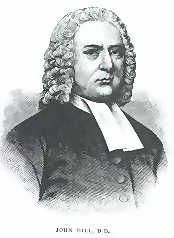
God is unchangeable in his purposes and decrees, there is a purpose for everything, and a time for that purpose; God has determined all that ever was, is, or shall be; all things come to pass according to the counsel of his will, and all his decrees are unchangeable; they are like the laws of the Medes and Persians, and more unalterable than they were; they are the mountains of brass Zechariah saw in a vision, from whence proceed the providences of God, and the executioners of them (Zech. 6:1), called “mountains” because of their immoveableness, and mountains of “brass” to denote their greater firmness and stability: immutability is expressly spoken of the counsel of God (Heb. 6:17), the purposes of God are always carried into execution, they are never frustrated; it is not in the power of men and devils to disannul them; whatever devices and counter workings to them may be framed and formed, they are of no avail; “the counsel of the Lord stands for ever” (Ps. 33:11; Prov. 19:21, 21:30; Isa. 14:24, 27, 46:10), the purposes of God are “within” himself (Eph. 1:9), and what is in himself, is himself, and he can as soon cease to be as to alter his mind, or change his counsels; and they are “eternal” (Eph. 3:11) no new thoughts arise in his mind, no new resolutions are formed in his breast, no new decrees are made by him; his counsels are “of old”; and his purposes are called “counsels”, because designs wisely formed by men, are with consultation, and upon mature deliberation: and such are the decrees of God, they are made with the highest wisdom by him, who is wonderful in counsel, and excellent in working, and so are unchangeable: and besides, being “all-knowing”, he sees and declares the end from the beginning, and nothing unforeseen ever can appear to hinder the execution of his intentions and determinations; which is sometimes the case with men: and he is “able” to perform whatever he resolves upon; there is no lack of wisdom, nor of power in him, as often is in men; and he is “faithful” to himself, his purposes and decrees; his “counsels of old are faithfulness and truth”; or are truly and faithfully performed.
Monday, April 4, 2011
"12 Time Wasting Thieves" by Richard Baxter

"Redeeming the time." Colossians 4:5
"That you may live a life worthy of the Lord and may please Him in every way." Colossians 1:10
"That you may live a life worthy of the Lord and may please Him in every way." Colossians 1:10
Thief 1. One of the greatest time-wasting sins, consists of idleness or sloth.
Thief 2. The next thief or time-waster, is excess of sleep.
Thief 2. The next thief or time-waster, is excess of sleep.
Thief 3. Another time-waster, is an inordinate adorning of the body.
Thief 4. Another time-wasting thief, is unnecessary pomp and extravagance in household furniture and domestic entertainments.
Thief 5. Another time-wasting sin, is needless feastings, gluttony, and drinking.
Thief 6. Another time-waster, is idle talk.
Thief 7. Another thief which would steal your time, is vain and sinful company.
Thief 8. Another notorious time-wasting thief, is needless, inordinate sports and games--which are masked with the deceitful title of recreations.
Thief 9. Another time-wasting thief, is excess of worldly cares and business.
Thief 10. Another time-waster, is vain, ungoverned and sinful thoughts.
Thief 11. Another dangerous time-wasting sin, is the reading of worthless books, plays, romances, and novels. And also unprofitable studies, undertaken but for pride and vain-glory, or the pleasing of a carnal or curious mind.
Thief 12. But the master-thief that robs men of their time, is an unsanctified, ungodly heart; for this loses time, whatever men are doing--because they never intend to do anything for the glory of God.
"So whether you eat or drink or whatever you do--do it all for the glory of God!" 1 Corinthians 10:31
Thief 4. Another time-wasting thief, is unnecessary pomp and extravagance in household furniture and domestic entertainments.
Thief 5. Another time-wasting sin, is needless feastings, gluttony, and drinking.
Thief 6. Another time-waster, is idle talk.
Thief 7. Another thief which would steal your time, is vain and sinful company.
Thief 8. Another notorious time-wasting thief, is needless, inordinate sports and games--which are masked with the deceitful title of recreations.
Thief 9. Another time-wasting thief, is excess of worldly cares and business.
Thief 10. Another time-waster, is vain, ungoverned and sinful thoughts.
Thief 11. Another dangerous time-wasting sin, is the reading of worthless books, plays, romances, and novels. And also unprofitable studies, undertaken but for pride and vain-glory, or the pleasing of a carnal or curious mind.
Thief 12. But the master-thief that robs men of their time, is an unsanctified, ungodly heart; for this loses time, whatever men are doing--because they never intend to do anything for the glory of God.
"So whether you eat or drink or whatever you do--do it all for the glory of God!" 1 Corinthians 10:31
Sunday, April 3, 2011
Sabbath Sermon - Confident in the Truth (R.C. Sproul)
This Christian Sabbath (after going to your local church) why not take the time to listen to the following sermon:

Subscribe to:
Comments (Atom)