Our Mission : To know Jesus and make Him known to the Glory of God!
Showing posts with label John Gill. Show all posts

Tuesday, April 12, 2011

John Gill on "The Immutability of God's Love"


God is unchangeable in his love and affections to his people; “his love to them is from everlasting to everlasting”, without any variation in his own heart, however different the manifestations of it may be to them; he ever rests in his love, and never alters, nothing can separate from it, he is love itself, and it is as unchangeable as himself, “the same today, yesterday, and for ever”: the fall made no difference in it, though the special objects of it fell with Adam, in his transgression, into the depths of sin and misery; this hindered not, but God continued his love, and manifested it in sending his Son to be the propitiation for their sins, and commended it, and gave a full proof and demonstration of it, in the delivery of Christ to death for them, even while they were yet sinners: nor does the sinful state and condition they were brought into, and continue in from their birth to their conversion, make any alteration in his love; but notwithstanding that, for the great love with which he loves them, he “quickens them when dead in trespasses and sins”; he looks upon them in all the impurity of their natural state, and says to them, “live”; and this time, as it is a time of life, it is a time of open love (see Eph 2:4, 5; Ezek. 16:6-8; Titus 3:3-5). Nor do the hidings of God’s face from them after conversion, prove any change in his love to them; for though he hides his face from them, and forsakes them for a moment, in a little seeming wrath, to show his resentment at their sins, to bring them to a sense of them, to humble them before him, and to cause them to seek his face and favour; yet with great mercies he gathers them again to himself, in the most tender manner, and with lovingkindness, has mercy on them; and, for the strengthening of their faith in his love, swears he will not be wroth with them; and declares his lovingkindness to be more immoveable than hills and mountains (Isa. 54:7-10). Afflictions are no evidence of a change of affections to them; though he may thoroughly chastise them, and, as they may think, severely, yet he deals with them but as children; and, like Ephraim, they are his dear sons and daughters, and pleasant children, in whom he takes the utmost complacency and delight; chastenings are rather proofs of sonship, than arguments against it. God’s rebukes of them are rebukes in love, and not in wrath and hot displeasure; though he visits their transgressions with a rod and stripes, he does not utterly, nor at all, take away his lovingkindness in Christ from them (Jer. 31:18, 20; Heb. 12:6-8; Rev. 3:19; Ps. 89:32, 33). Nor is the unchangeableness of the love of God to his people to be disproved by his being said to be angry with them, and then to turn away his anger from them (Isa. 12:1), for anger is not opposite to love. Jacob was angry with his beloved Rachel, and a father may be angry with his beloved child, and love him not the less. Wrath and hatred are opposed to love, which are never in the heart of God towards his beloved ones: besides, this is said after the manner of men, and according to our apprehension of things; the Lord doing somewhat similar to men when they are angry, who frown and turn away; and when God frowns in his providence, and deserts his people for a while, they judge he is angry, when it only shows his discipline at their sins, but not at their persons; and then, when he smiles upon them again, and manifests his pardoning grace and mercy, they conclude he has turned himself from the fierceness of his anger (Ps. 85:2, 3).

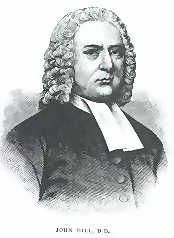
Tuesday, April 5, 2011

John Gill on "The Immutability of God's Decrees"


God is unchangeable in his purposes and decrees, there is a purpose for everything, and a time for that purpose; God has determined all that ever was, is, or shall be; all things come to pass according to the counsel of his will, and all his decrees are unchangeable; they are like the laws of the Medes and Persians, and more unalterable than they were; they are the mountains of brass Zechariah saw in a vision, from whence proceed the providences of God, and the executioners of them (Zech. 6:1), called “mountains” because of their immoveableness, and mountains of “brass” to denote their greater firmness and stability: immutability is expressly spoken of the counsel of God (Heb. 6:17), the purposes of God are always carried into execution, they are never frustrated; it is not in the power of men and devils to disannul them; whatever devices and counter workings to them may be framed and formed, they are of no avail; “the counsel of the Lord stands for ever” (Ps. 33:11; Prov. 19:21, 21:30; Isa. 14:24, 27, 46:10), the purposes of God are “within” himself (Eph. 1:9), and what is in himself, is himself, and he can as soon cease to be as to alter his mind, or change his counsels; and they are “eternal” (Eph. 3:11) no new thoughts arise in his mind, no new resolutions are formed in his breast, no new decrees are made by him; his counsels are “of old”; and his purposes are called “counsels”, because designs wisely formed by men, are with consultation, and upon mature deliberation: and such are the decrees of God, they are made with the highest wisdom by him, who is wonderful in counsel, and excellent in working, and so are unchangeable: and besides, being “all-knowing”, he sees and declares the end from the beginning, and nothing unforeseen ever can appear to hinder the execution of his intentions and determinations; which is sometimes the case with men: and he is “able” to perform whatever he resolves upon; there is no lack of wisdom, nor of power in him, as often is in men; and he is “faithful” to himself, his purposes and decrees; his “counsels of old are faithfulness and truth”; or are truly and faithfully performed.

Thursday, March 31, 2011

Question: If God ordains all things, then why pray?


Should it be said, to what purpose then is prayer?

It is answered, this is the way and means God has appointed, for the communication of the blessings of his goodness to his people; for though he has purposed, provided, and promised them, yet he will be sought unto, to give them to them, and it is their duty and privilege to ask them of him; and when they are blessed with a spirit of prayer, it forebodes well, and looks as if God intended to bestow the good things asked; and which should be asked always with submission to the will of God, saying, “not my will, but thine be done”.

by John Gill

Monday, March 21, 2011

The heathen know that God exists - John Gill

John Gill tells how the native Greenlanders knew of God before Christianity even arrived on their shores.

Most admirable was the reasoning of a wild Greenlander, which he declared to a missionary to be the reasoning of his mind before his conversion; he said to him, “It is true we were ignorant heathens, and knew nothing of God, or a Saviour; and, indeed, who should tell us of him till you come? but thou must not imagine that no Greenlander thinks about these things. I myself have often thought: a “kajak” (a boat) with all its tackle and implements, does not grow into existence of itself; but must be made by the labour and ingenuity of man; and one that does not understand it would directly spoil it. Now the meanest bird has far more skill displayed in its structure, than the best “kajak”; and no man can make a bird: but there is still a far greater art shown in the formation of a man, than of any other creature. Who was it that made him? I thought myself that he proceeded from his parents, and they from their parents; but some must have been the first parents; whence did they come? common report informs me, they grew out of the earth: but if so, why does it not still happen that men grow out of the earth? and from whence did this same earth itself, the sea, the sun, the moon, and stars, arise into existence? Certainly there must be some Being who made all these things; a Being that always was, and can never cease to be. He must be inexpressibly more mighty, knowing, and wise, than the wisest man. He must be very good too, because that everything that he has made is good, useful, and necessary for us. Ah, did I but know him, how would I love him and honour him! But who has seen him? who has ever conversed with him? None of us poor men. Yet there may be men too that know something of him. O that I could but speak with such! therefore,” he said, “as soon as ever I heard you speak of this great Being, I believed it directly, with all my heart; because I had so long desired to hear it.”

Tuesday, March 15, 2011

John Gill on Natural Revelation


There is nothing in the whole creation the mind can contemplate, the eye look upon, or the hand lay hold on, but what proclaims the Being of God.

When we look up to the heavens above us; the surrounding atmosphere; the air in which we breathe, which compresses our earth, and keeps it together; the stellar space, and spreading sky, bespangled with stars of light, and adorned with the two great luminaries, the sun and moon, especially the former, that inexhaustible fountain of light and heat; and under whose benign influences, so many things are brought forth on earth; whose circuit is from one end of the heaven to the other; and there is nothing hid from the heat thereof: when we consider its form, magnitude, and virtue; its proper distance from us, being not so near us as to scorch us; nor so remote as to be of no use to us; the motion given it at first, in which it has proceeded without stopping, but once as is supposed, in the days of Joshua; a motion it has had now almost six thousand years; the course it has steered, and steers, so that all parts of the earth, at one season or another, receive benefit by it; and the way it has been guided in, without varying or erring from it all this while.

Whoever reflects on these things, must acknowledge it to be the work of an all wise and almighty agent, we call God; and that it must be upheld, guided, and directed by his hand alone. When we take a view of the earth, of the whole terraqueous globe, hanging on nothing, like a ball in the air, poised with its own weight; the different parts of it, and all disposed for the use of man; stored with immense riches in the heart of it, and stocked with inhabitants upon it; the various sorts of animals, of different forms and shapes, made, some for strength, some for swiftness, some for bearing burdens, and others for drawing carriages, some for food and others for clothing: the vast variety of the feathered birds that cut the air; and the innumerable kinds of fishes that swim the ocean.

The consideration of all this will oblige us to say, “Lord, thou art God, which hast made the heaven, earth, and sea; and all that in them is” (Acts 4:25). In short, there is not a shell in the ocean, nor a sand on the shore, nor a spire of grass in the field, nor any flower of different hue and smell in the garden, but what declare the Being of God: but especially our own composition is deserving of our notice; the fabric of the body, and the faculties of our souls. The body, its form and shape; while other animals look downwards to the earth, “os homini sublime dedit Deus”, as the poet says, man has a lofty countenance given him, to behold the heavens, to lift up his face to the stars; and for what is this erect posture given him, but to adore his Creator? And it is remarkable that there is a natural instinct in men to lift up their hands and eyes to heaven, when either they have received any unexpected mercy, by way of thankfulness for it; or are in any great distress, as supplicating deliverance from it; which supposes a divine Being, to whom they owe the one, and from whom they expect the other.